cuernylabs.ai
Move Beyond Legacy. Build at the Speed of AI.

Build vs Buy Isn’t a Debate. It’s an Architectural Decision.
Off-the-shelf platforms promise speed — but often impose hidden constraints, long-term cost, and architectural debt.Many teams default to buying because building feels slow and risky.
In practice, the opposite is often true.We help teams evaluate when a commercial platform accelerates delivery — and when it quietly becomes the bottleneck.

How We Evaluate the Decision
We examine systems through the constraints that actually shape outcomes — not through ideology or vendor preference.Build versus buy decisions rarely fail because of the choice itself.
They fail because teams underestimate the constraints that choice introduces.We evaluate architectures by instrumenting the system — surfacing where complexity accumulates, where flexibility erodes, and where future change becomes expensive.Our approach focuses on understanding the system as it exists today and how it will behave under real operational pressure, not just initial delivery.
Time-to-value versus time-to-change
Configuration ceilings versus custom logic
Vendor dependency and exit cost
Data ownership, observability, and control
Cost and operational risk as the system scales

Get a Clear Build vs Buy Recommendation
A short engagement that delivers a defensible architectural decision — not a slide deck.
You’ll speak directly with an engineer. No sales team. No pressure.
Don't Replace Your Legacy. Evolve it.
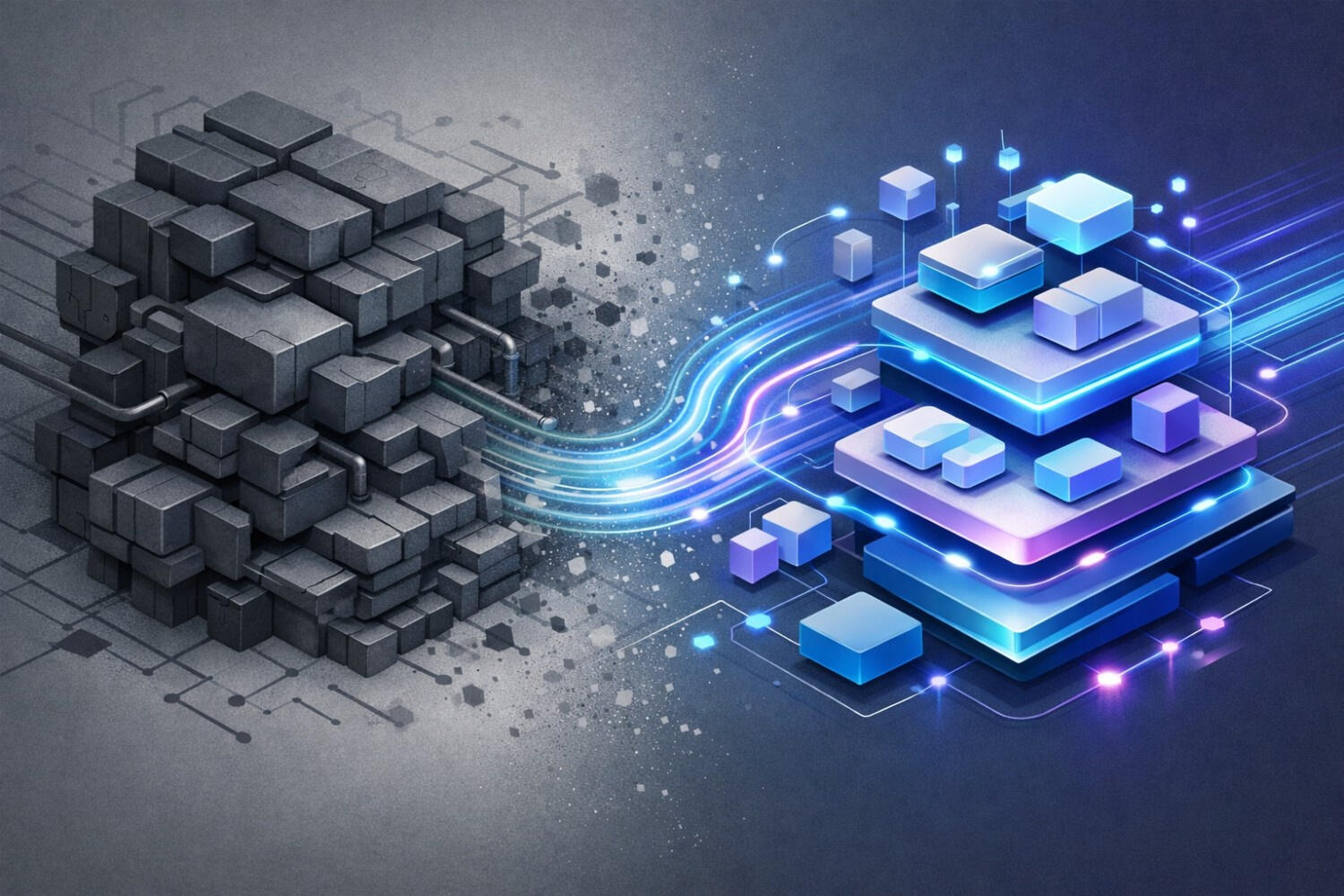
Legacy systems often encode years of business logic — replacing them outright is risky and unnecessary.We help teams incrementally deconstruct legacy monoliths, isolate critical paths, and rebuild high-leverage components into modern, high-performance systems — without disrupting the business.The result is forward progress without the cost, downtime, or failure risk of a full rewrite.
A 30-minute deep dive with a technical expert. No sales pitch, just a path forward.
Why Teams Choose CuernyLabs
Elite Efficiency — A small, senior-only team eliminates communication overhead and shipping delays.Custom Without the Wait — Modern stacks and internal frameworks move from concept to production in weeks, not quarters.Founder-Led Development — Your system is architected and built by senior engineers who have designed and delivered complex platforms for enterprises at scale.

© Untitled. All rights reserved.
Founders

Benjamin Peters | Founder & CTO
Benjamin is a veteran software engineer with over a decade of experience building mission-critical infrastructure for industry leaders like Atlassian, Visa, Secureworks, Anaconda, and Oracle. A Carnegie Mellon alumnus with a Master’s in Information Systems Management, he specializes in the high-stakes intersection of MLOps, Fintech, and AI-Native architecture.Currently a Senior Engineer at Atlassian, Benjamin is at the forefront of AI-native development, leading the creation of autonomous systems that solve complex business logic and infrastructure challenges. He founded CuernyLabs to bring this same "Big Tech" caliber engineering to companies that need custom, high-performance software without the bloated SaaS price tag or slow corporate roadmaps.

Chenyuan Zhang | Cofounder & Principal Architect
Chenyuan is a software architect and Carnegie Mellon MISM alumna with over a decade of experience building high-scale, data-intensive systems at industry leaders like Indeed, WorldQuant, and Anaconda.Most recently as a Staff Software Engineer at Indeed, she pioneered AI-powered job search recommendation engines to optimize how millions of users discover opportunities. Her technical pedigree includes architecting dependency-driven DAG scheduling systems for large-scale ML workloads and engineering high-throughput event-driven systems for Alpha Generation, providing the critical buy/sell signals used by portfolio managers to drive investment strategies. At CuernyLabs, she applies this background in AI-native discovery and system orchestration to build lean, enterprise-grade assets that solve complex business logic without the overhead of traditional agency models.
Technical Briefs
Let’s Architect Your Next Move
Whether you're deconstructing a legacy monolith or building a new AI-native platform, we’re here to help you move faster. Drop us a note about your technical hurdles, and let's see if we’re the right fit to solve them.
Quote-to-Cash Platform (Build vs Buy)A large enterprise sales organization needed a production-ready Quote-to-Cash (Q2C) system to enable sales teams to generate accurate customer quotes.Commercial Q2C platforms were evaluated, but the organization faced:
- Significant customization requirements
- Complex integration needs
- A hard deadline: one quarter to deliver a usable systemThe mandate was clear:
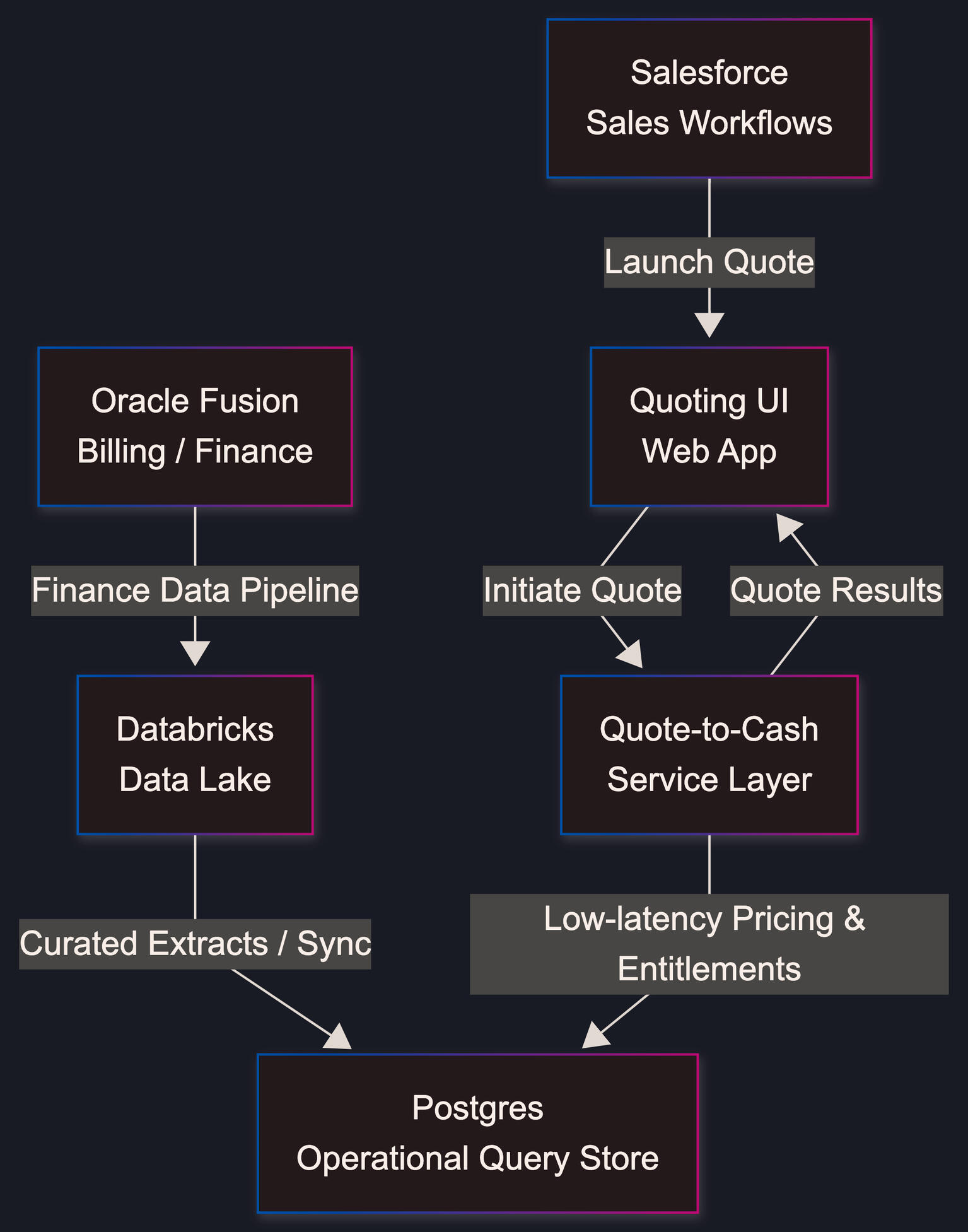
make the build vs buy decision and deliver a working v1 in 90 days.The ChallengeThe challenge was not just building a quoting interface — it was orchestrating data across fragmented enterprise systems:- Sales workflows lived in Salesforce
- Pricing, entitlements, and billing data originated in Oracle Fusion
- Historical and operational data already existed in a Databricks data lakeOff-the-shelf platforms introduced:
- Long implementation timelines
- Limited flexibility for complex pricing logic
- High integration overhead relative to the delivery windowBuying introduced schedule risk due to implementation timelines, while building required careful control of scope and production readiness.The DecisionWe led a focused Build vs Buy assessment centered on:
- Time-to-value within a fixed quarter
- Leveraging existing enterprise data assets
- Control over pricing and quoting logic
- Long-term extensibility beyond v1A key factor was the organization’s existing investment in a Databricks data lake containing curated finance and billing data already sourced from Oracle Fusion.Leveraging this foundation allowed us to bypass large portions of a commercial platform and focus the build on orchestration and quoting logic.
The outcome was to build a targeted, production-grade Q2C system, designed specifically around the organization’s data and workflows — avoiding the weight of a full commercial platform.The ApproachRather than attempting a full end-to-end replacement, the system was designed as a thin orchestration layer:- Salesforce remained the system of engagement for sales
- Databricks served as the authoritative source for pricing and billing data
- Oracle Fusion continued to own billing and financial truth
- The new service layer focused exclusively on:
- Quote generation
- Pricing composition
- Validation and approvalsThis approach allowed the team to:
- Reuse trusted enterprise data
- Avoid duplicating financial logic
- Deliver quickly without architectural shortcutsThe OutcomeWithin a single quarter, the team delivered:
- A production-ready v1 Quote-to-Cash system
- Seamless Salesforce integration for sales users
- Accurate quoting powered by existing billing data
- A clean architectural foundation for future expansionThe system:
- Met the delivery deadline
- Avoided vendor lock-in
- Scaled naturally as requirements evolvedWhy This MattersThis engagement demonstrates that Build vs Buy isn’t about ideology — it’s about constraints.By grounding the decision in:
- Timeline
- Existing data assets
- Operational realitiesAs a result, the quoting process shifted from multi-day (and in some cases multi-week) turnaround to minutes for standard quotes, dramatically improving sales responsiveness.The result was a system that:
- Replaced a slow, manual quoting process with a production-grade automated workflow
- Leveraged existing enterprise data rather than duplicating financial logic
- Fit real sales and billing processes without forcing teams into a generic platform
Coming Soon
Coming Soon
Coming Soon